Gold had its worst week in more than eight months as the dollar climbed. A data-packed Wednesday now tests December's hike bets.
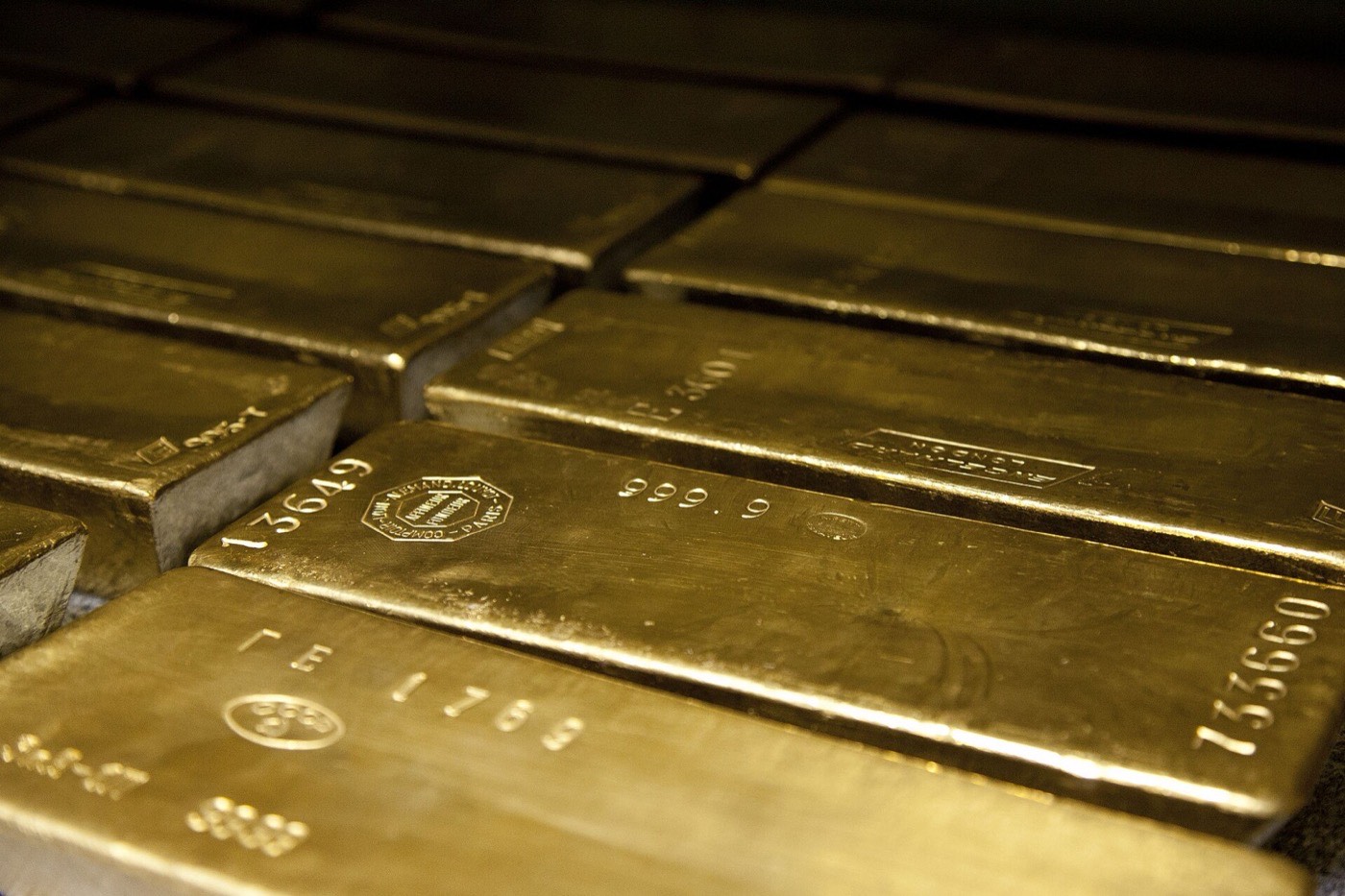 Photo: Andrzej Barabasz, CC BY-SA 4.0
Markets spent the past week caught between a retreat from risk and stubbornly high inflation. Minutes of the Federal Reserve's October meeting showed that almost all officials think further rate hikes will probably be appropriate, and expectations of tighter policy are back in charge of how assets are priced.
Last week: the dollar up, gold down hard
The dollar kept the upper hand. The dollar index came close to 104 during the week, its highest in about 19 months, before giving back a little. It still logged a fourth straight weekly gain and closed Friday at 103.87, up 0.44% on the day.
Precious metals were at the centre of the selling. A rising dollar, higher real interest rates and selling to raise cash as stock markets fell all weighed on gold. Spot gold fell about 8.9% on the week, its biggest weekly drop since March, and closed Friday at $3,538 an ounce.
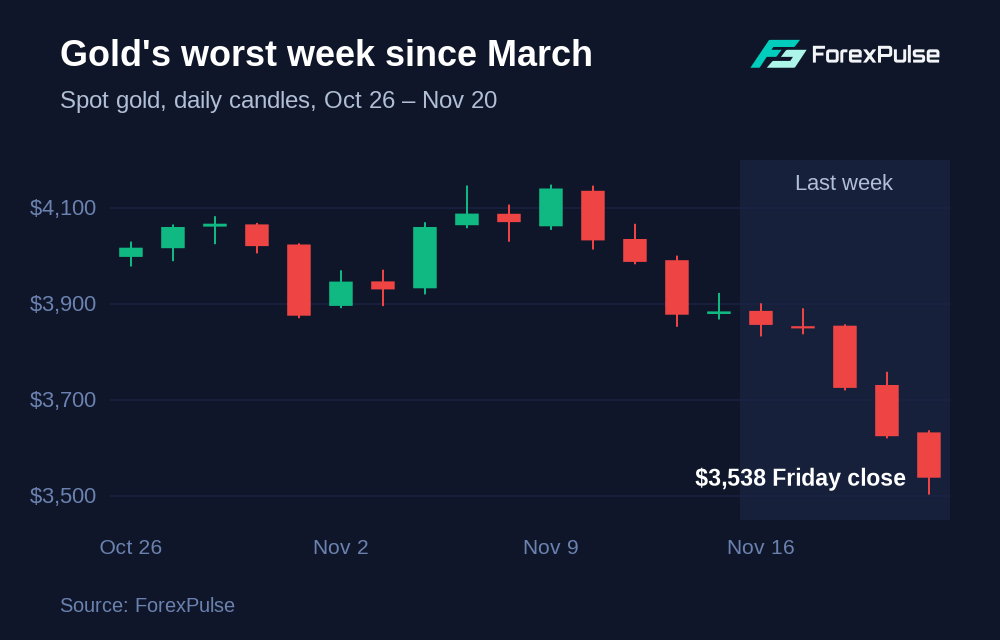 Gold held between roughly $3,900 and $4,150 for three weeks, then fell every day last week.
Silver broke through seven price levels in a single week and fell below $41, about $80 below its January high. It closed Friday at $40.96, down about 15.5% on the week. Platinum and palladium fell with it.
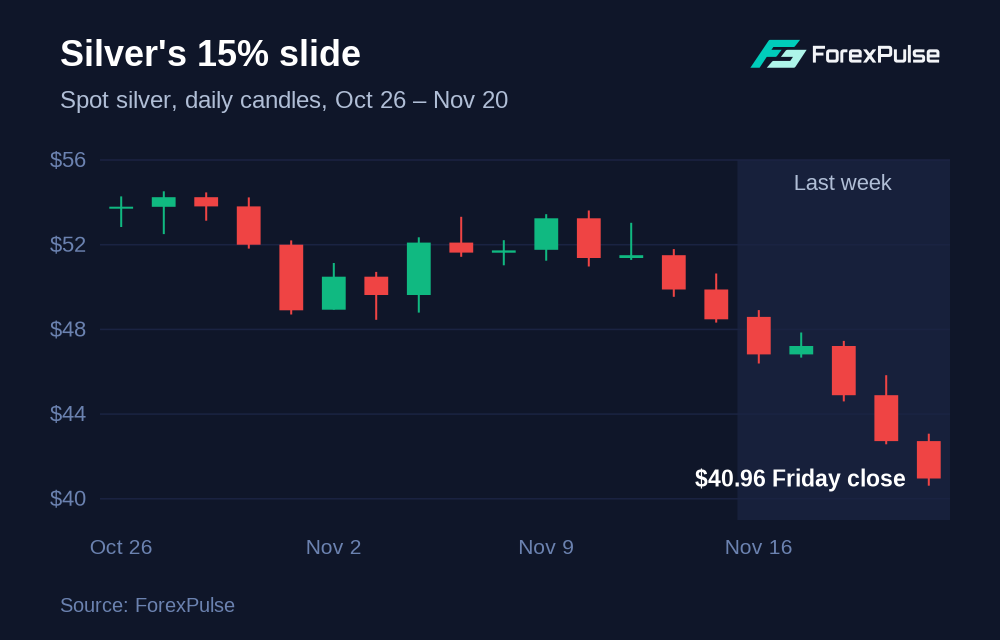 Silver fell on four of last week's five days and ended at $40.96.
Oil fell for a third straight week. Larger-than-expected builds in US crude and fuel inventories, the resumption of Middle East exports and expectations of oversupply all pushed prices lower. Attacks on shipping in the Strait of Hormuz and conflict in the region limited the downside, leaving oil swinging between loose fundamentals and a geopolitical premium.
 Photo: DmitTrix, CC BY 4.0
Other currencies were broadly weaker against the dollar:
- EUR/USD briefly fell below 1.10.
- GBP/USD slipped to around 1.31, close to a one-year low.
- USD/JPY neared 160, a level where the risk of intervention rises.
- AUD/USD dropped to about a 10-month low after weak jobs data.
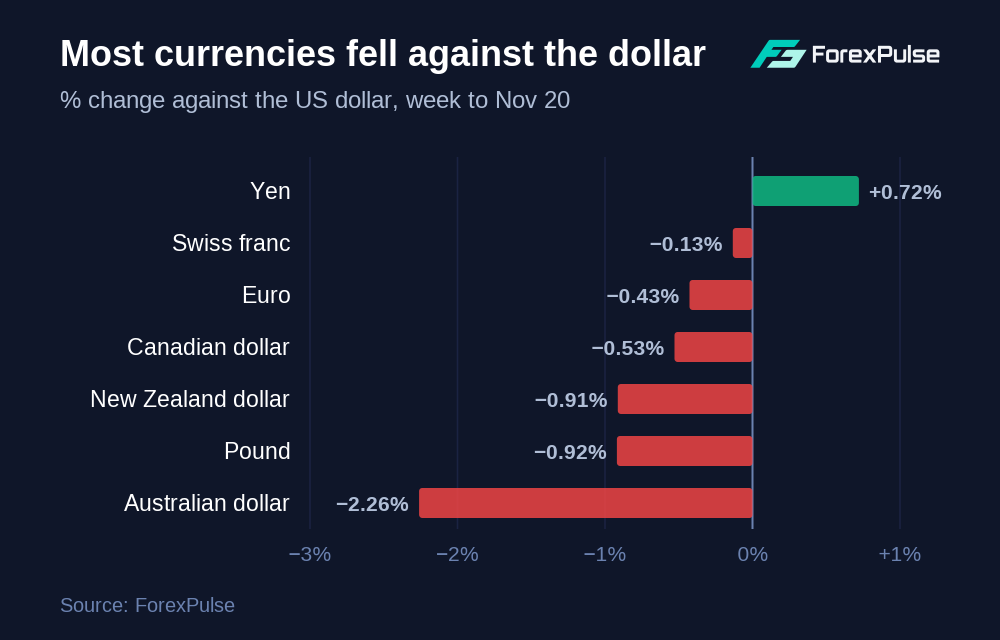 Six of the seven major currencies fell against the dollar last week. The yen was the exception, gaining 0.72% as USD/JPY pulled back from 160.
Geopolitics: the White House wants a Ukraine ceasefire by January 3
Markets will watch the progress of Ukraine ceasefire talks. According to the Financial Times, the Trump administration has told European and Ukrainian officials it wants the talks finished by January 3. That is when the new Congress convenes, with Democrats taking control after winning the midterm elections, and the White House's window to push a deal is seen as narrowing.
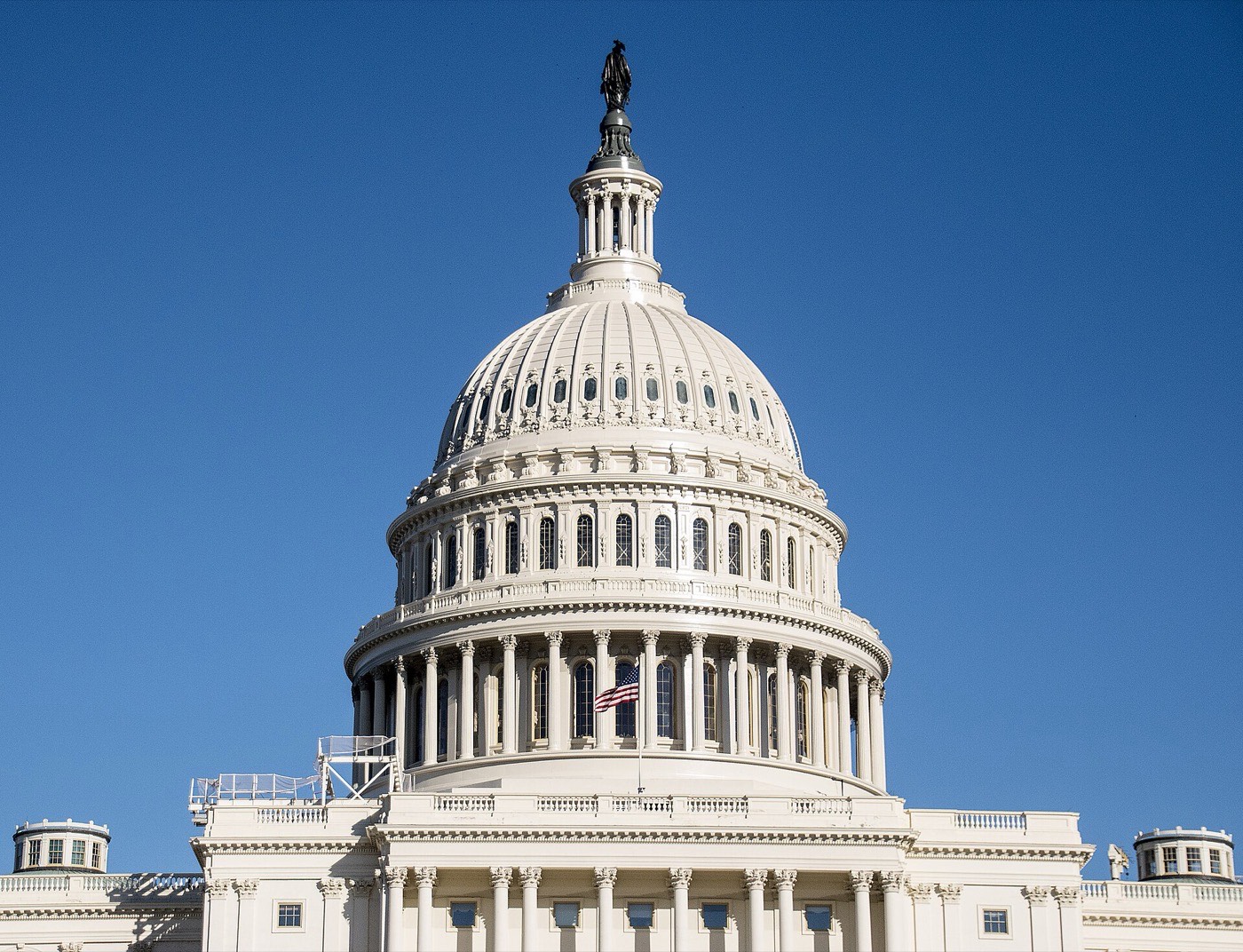 Photo: Ron Cogswell, CC BY 2.0
European resistance is growing. One European official who met the US envoys said Washington was pushing hard and worried that Ukraine might have to make major concessions to get close to a deal. Another noted the difference in pace: the Americans are in a hurry, Putin is not. A senior Ukrainian official feared the US deadline could force Kyiv to accept Russia's terms, since an early deal would give Moscow better conditions.
US envoy Steve Witkoff and Jared Kushner, Trump's son-in-law, have been shuttling between Moscow, Dublin and Berlin to meet Russian, Ukrainian and European officials. Part of the urgency is domestic: Trump currently has broad authority to broker a ceasefire, but that could change once Democrats control Congress. They plan to use their legislative powers to strengthen support for Ukraine, tighten sanctions on Russia and scrutinize Trump's foreign policy, as well as the business interests of Witkoff and Kushner.
 Photo: Andrew Milligan sumo, CC BY 2.0
US officials have suggested Trump could discuss a ceasefire plan with European leaders at next month's G20 summit in Miami. A senior French official said Europe would not negotiate over Ukraine at the G20 because President Zelensky has not been invited; Trump has invited Putin. Observers broadly expect Russia to resist a quick ceasefire, and two sources said Moscow is using continued air strikes to strengthen its negotiating position.
Alongside Ukraine, US–Iran contacts are back in view. Axios reported that Witkoff and Kushner met Qatari officials, who are mediating a return to US–Iran talks, in Berlin on Thursday, with Qatar's prime minister reportedly present; the White House did not confirm it. Trump told reporters the same day that Iran wants a deal, but not one he can accept.
Progress or setbacks on either front feed straight into safe-haven demand for gold and into the risk premium in oil.
Central banks: Williams and the Beige Book
All times are New York time.
- Mon Nov 23, 4:00 pm: New York Fed President John Williams, a permanent FOMC voter, speaks
- Tue Nov 24, 11:30 am: Bank of Canada Governor Tiff Macklem speaks
- Wed Nov 25, 2:00 pm: Fed Beige Book on economic conditions
- Thu Nov 26, 7:30 am: ECB accounts of its October policy meeting
With the December Fed meeting approaching, Williams's remarks and the Beige Book offer a window into policymakers' thinking.
 Photo: Kidfly182, CC BY 4.0
The divisions over the policy path are now in the open. In his six months in office, Fed Chair Kevin Warsh has deliberately avoided giving guidance on the direction of rates, and his colleagues have been happy to fill the gap. Bank of America counts more public remarks by Fed officials over the past two weeks than in any comparable period since early 2025.
Some officials prefer to move meeting by meeting as the data come in; others are openly discussing shortening the gap between hikes. That burst of commentary helps explain why market pricing for December has converged so quickly over the past two weeks.
The case for further hikes has the upper hand. In a speech prepared for a central bank conference in Chile, Governor Lisa Cook said the current policy rate is not high enough to bring inflation down and that she is highly concerned about the inflation readings. In a different environment the committee could afford to be patient, she said, but not in this one. In her view, the 25 basis-point hike at the September 15–16 meeting was not enough, and inflation data since then have not shown convincing evidence of a sustained return to target.
More aggressive options are on the table too. CNBC reported that Governor Christopher Waller and St. Louis Fed President Alberto Musalem have both discussed raising rates faster. The October minutes showed almost all participants saw further hikes as likely appropriate, and some suggested a larger move in December if inflation data were unfavourable.
Political pressure is coming from the other direction. Trump again called on the Fed to cut rates this week, saying rates are too high because the Fed is very political. With markets already treating a December hike as likely, that tension between the White House and the Fed looks set to continue.
For the coming week, what Williams says and how the Beige Book describes regional economies will test whether officials' consensus for more hikes holds.
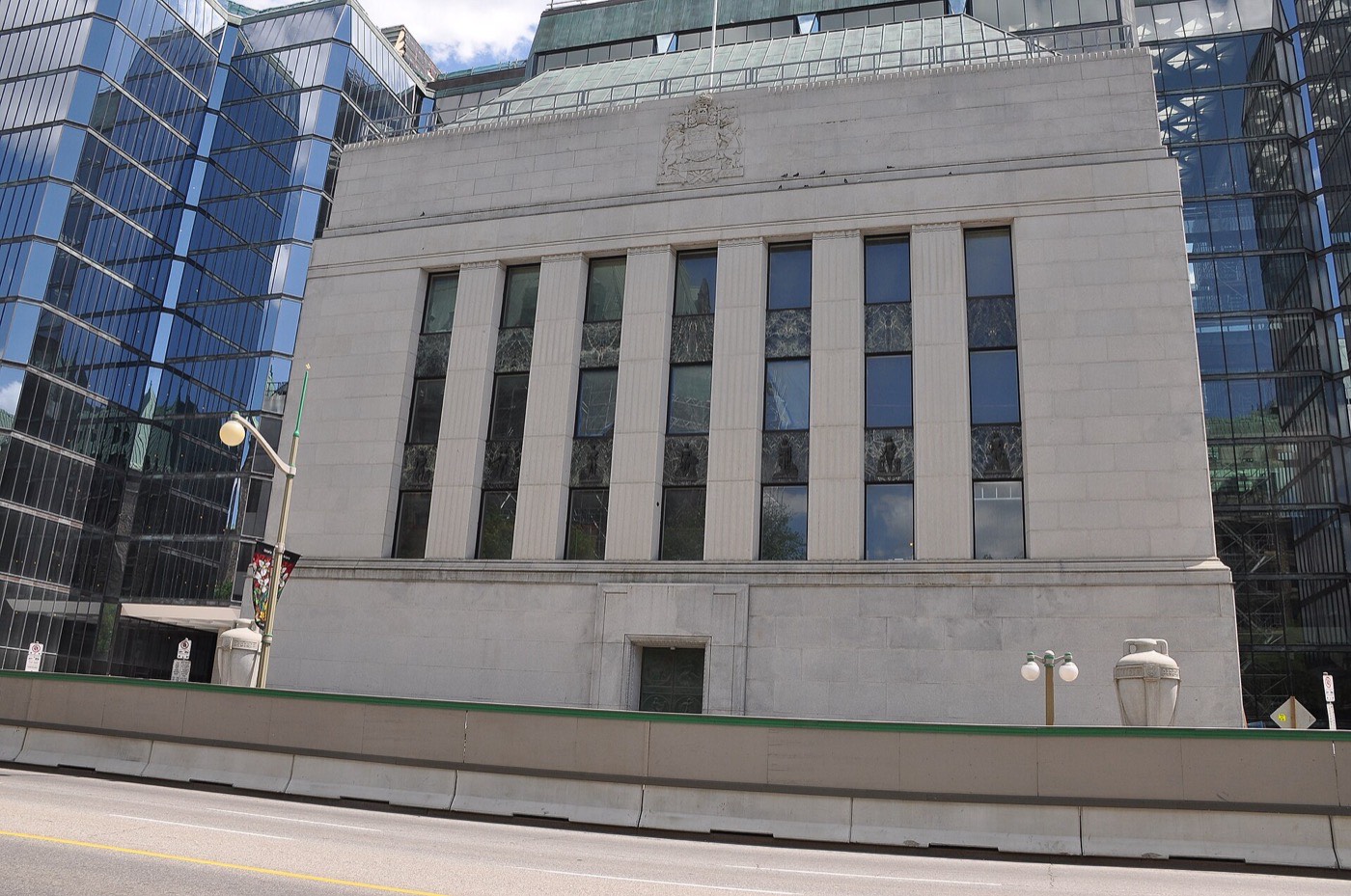 Photo: shankar s., CC BY 2.0
Neither the Bank of Canada nor the ECB has a rate decision this week, so the focus is on wording. In Canada, recent jobs data have weakened, and markets will watch whether Macklem signals his next move more clearly. In Europe, the October accounts are expected to show differences within the Governing Council over how fast inflation is coming down, and what to do next. With the dollar strong and the euro briefly below 1.10, how much room the ECB has, and how carefully it phrases it, is also in focus.
 Photo: Thomas Wolf, www.foto-tw.de, CC BY-SA 3.0 DE
Data: October core PCE leads a front-loaded week
October's core PCE price index, the Fed's preferred measure of underlying inflation, comes out Wednesday at 8:30 am. The market expects the annual rate to rise to 3.2% from 3.1%. Personal spending, the monthly core PCE figure, the second estimate of third-quarter GDP and October durable goods orders arrive at the same time.
RBC's forecast is more aggressive. The bank expects both headline and core PCE prices to rise 0.3% on the month in October, taking the annual rates to 3.8% and 3.3%, and argues that inflation is re-accelerating. Without a drop in airfares in producer prices, it says, the readings could have been higher. The real question is whether consumers can keep absorbing the pass-through of higher energy prices. October retail sales suggest households are coping for now, at the cost of a lower saving rate and rising interest payments.
 Photo: ajay_suresh, CC BY 4.0
The resilience of the labour market matters too. Initial jobless claims for the week to November 21 are expected at 197,000, down from 203,000. Another low reading on top of rising inflation would strengthen the case for a December hike.
Gold has been sensitive to this release. Across the 27 core PCE releases in the ForexPulse calendar history, gold moved an average of 0.16% in the first 15 minutes and 0.30% in the first hour, in either direction.
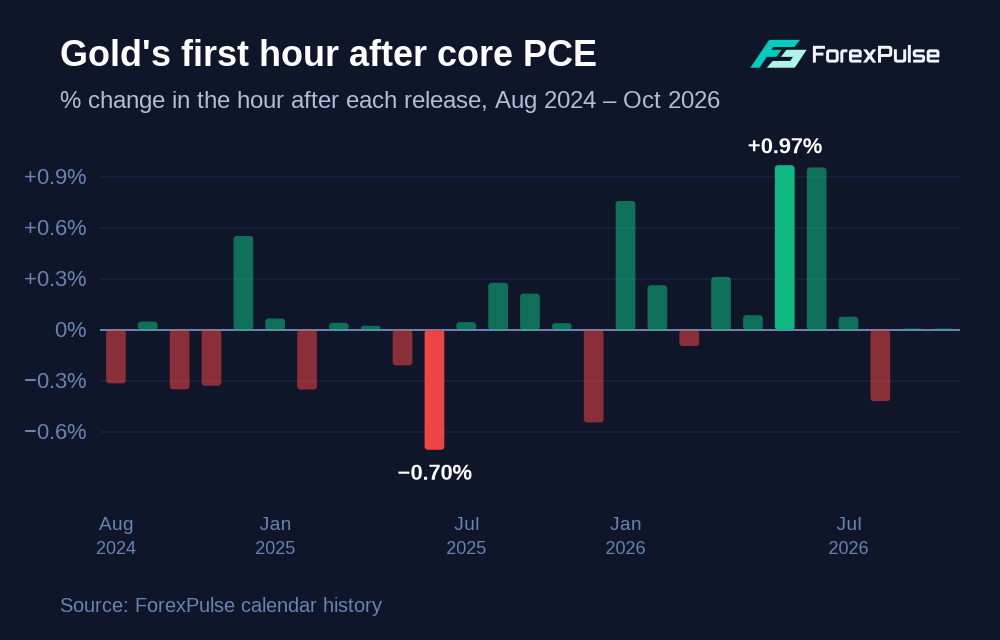 Gold's first-hour move after each of the last 27 core PCE releases. It rose after 18 of them.
After a run of heavy down candles, selling pressure on gold has not eased. If core PCE comes in as hot as RBC expects, higher real interest rates would make gold less attractive still. A softer reading would leave room for a rebound after such a steep fall. That tug of war is the main thread for precious metals this week.
Thanksgiving pulls US data forward into Wednesday. Thursday and Friday are much quieter, leaving European data to set the tone for the rest of the week.
Holiday trading hours
- Mon Nov 23: Japan is on holiday (Labor Thanksgiving Day), so expect thinner yen liquidity in Asian hours.
- Thu Nov 26: US Thanksgiving. US stock markets are shut; CME precious metals and US crude futures stop trading early at 2:30 pm, and ICE Brent at 1:30 pm.
- Fri Nov 27: CME precious metals, US crude and FX futures end early at 2:45 pm, and ICE Brent at 3:00 pm.
 Photo: Igge, CC BY-SA 4.0
Follow every release this week, with gold's reaction history for each, in the ForexPulse calendar.
Market commentary, not financial advice.